What is Montessori?
Origin
The Montessori approach to education of the child is based on the principles developed in the early 1900’s by an Italian physician and educator, Dr Maria Montessori.
Dr Montessori has since become recognised as an outstanding pioneer in early-years education and her ideas have filtered through into mainstream education today. Dr Montessori was nominated for the Nobel Peace Prize in 1949, 1950 and 1951.
Each nomination acknowledged her work toward achieving world peace through education, starting with the youngest child and continuing on ever more complex levels throughout the academic years.
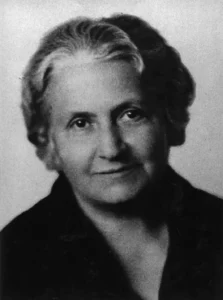 “Learning the correct answers will get a child through school, but learning how to learn is a preparation for life.”
Dr Maria Montessori, 1932
Definition
Quite simply, the Montessori approach unleashes a child’s natural curiosity in a controlled manner and directs it in a purposeful way. The main tenets underpinning the Montessori philosophy are:
Further Information
Montessori nurseries differentiate themselves clearly from other nurseries by the environment created in the classroom. The furniture, teaching materials and learning tools are designed to establish an environment where the child experiences learning which is fascinating and absorbing, stimulating further discovery, rational thought and independence.
With such experiences developed in the formative years, a positive attitude to learning is established and carries through to later life. The role of the ‘teacher’ is different from that of the conventional teacher. Through careful observation of the child, the ‘teacher’ identifies signs of readiness towards further progress, thereby directing the child towards activities that will fulfil the child’s individual needs.
Hence, a Montessori ‘teacher’ is referred to as a Directress. The Montessori approach is not simply concerned with intellectual development but seeks to create a ‘well-rounded’ individual. As well as mental development, physical, social and emotional development are also promoted in equal measures.
The Montessori approach is a universal one, equally suitable for the gifted and those with special needs, and thrives in an international or multi-cultural setting, as encountered at Daisies Montessori Nursery School. The overall goal is to foster a confident, happy child, instilled with an enthusiasm for learning and armed with a healthy respect for others.
A Montessori Directress is said to be: ‘Behind the child, to see were they have been, in front of the child, to see where they are going and next to the child in case they need help.’
My Montessori Child
My Montessori Child is pioneering software that helps us to deliver the best possible educational experience for young children. The system comprises two parts: an iPad-based wireless system for teachers to use on a daily basis in the nursery school environment, and a secure website that parents can access at any time from any internet-connected device.
When teachers observe a child engaged in an activity, their observation notes and a photo are recorded via the iPad into the child’s personal profile. Teachers are able to review their collective observations to ensure that each child’s development is properly supported in accordance with both Montessori principles and the Early Years Foundation Stage.
Each parents’ website is exclusively about their particular child and is regularly updated with the teachers’ observations. So, visiting the site each week, you will be able to review your child’s self-directed development as recorded by the teachers. The parents’ site also keeps you up-to-date with the class topics under study and suggests ideas for things that you can do at home to support your child’s learning at school. The website has notices posted for parents by teachers and lots of useful information, plus a simple online form that you can use to write to us on any non-urgent matter.